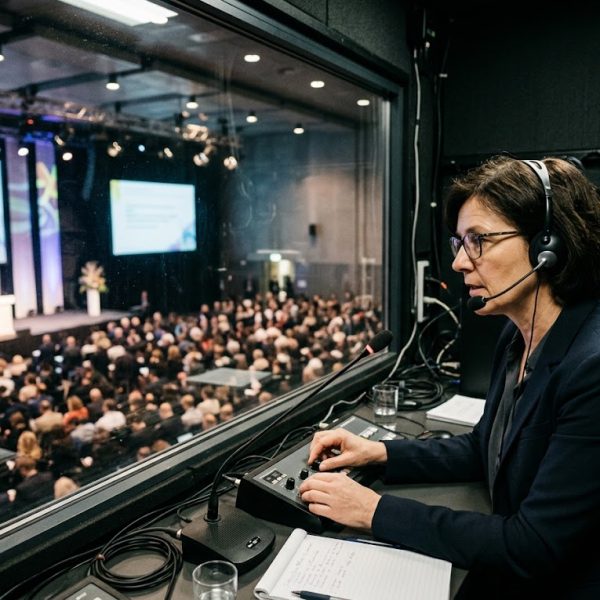
Fluency in two languages feels like the obvious requirement for an interpreter, but anyone who has watched a skilled professional work a live conference knows there is far more happening than word for word conversion. A speaker pauses, changes direction mid sentence, or drops in an idiom that has no clean equivalent, and the interpreter has a fraction of a second to make a judgment call that keeps the room following along.
Why Real Time Work Is a Different Skill Entirely
Written translation allows time to research a term, check a reference, or revise a sentence before anyone sees it. Live interpretation offers none of that. The best interpreters are not simply bilingual, they have trained themselves to listen, process, and speak almost simultaneously without losing accuracy under pressure. That skill takes years to build and is completely separate from general language fluency.
When French Speaking Audiences Need Specialized Support
Conferences and business meetings involving French speaking attendees often require more than a general translator. A team offering french translation services understands the formal register expected in professional settings, along with the regional differences that separate European French from Canadian French, ensuring nothing gets lost in a setting where tone matters as much as content.
Working Across Russian Speaking Delegations
International events with Russian speaking participants bring their own demands, particularly around technical or legal terminology that does not always have a direct equivalent. An interpreter experienced in russian to english translation can navigate these gaps in real time, choosing the phrasing that preserves both meaning and intent rather than defaulting to an awkward literal translation.
How Technology Supports Rather Than Replaces the Interpreter
While live interpretation itself remains a deeply human skill, the surrounding preparation increasingly relies on technology. Teams often use a translation platform beforehand to build a shared glossary of event specific terms, speaker names, and technical vocabulary, giving interpreters a consistent reference to draw on during the actual event rather than improvising unfamiliar terms on the spot.
The Preparation Nobody Sees
Before a major conference, interpreters typically review agendas, speaker bios, and any available slides or scripts well in advance. This preparation is what allows them to sound effortless during the actual event. An interpreter walking into an unfamiliar technical topic without this groundwork is far more likely to stumble on specialized vocabulary, no matter how strong their general language skills are.
Live interpretation requires more than fluency: it requires holding meaning while the speaker is still talking. Written work removes the time pressure but not the difficulty, which is why professional transcription services still depend on trained listeners rather than clean audio alone. Hearing accurately is a skill.
Fluency is the entry requirement; subject knowledge and preparation do the actual work. The same principle governs localization services, where knowing the language is assumed and knowing the product, market and conventions is what clients are paying for. Language is the medium, not the expertise.
Fluency is the entry requirement, not the qualification. Live work demands memory, note-taking, subject vocabulary and the composure to keep going when a speaker abandons the script. Anyone buying interpretation services on language ability alone tends to find that out during the event rather than before it.
Choosing an Interpreter for a High Stakes Event
Organizations planning an international conference or negotiation should look beyond language pairs alone when selecting an interpreter. Subject matter experience, whether in law, medicine, finance, or a specific industry, often matters as much as the language combination itself. An interpreter fluent in the languages but unfamiliar with the subject can still misrepresent a nuanced technical point.
The mode matters as much as the subject, and the two are usually settled together. At PoliLingua, for instance, simultaneous and consecutive interpreting are listed as distinct services, with conference, legal and medical work separated again beneath them. An organizer who names both the mode and the subject when requesting a quote ends up matched on the two things that actually decide how the day goes.
What This Means for Event Planners
Booking interpretation services well in advance gives professionals time to prepare properly rather than walking in cold. Sharing materials early, providing a glossary of key terms, and briefing interpreters on the format of the event all contribute directly to how smoothly communication flows on the day itself. The quality of live interpretation is decided long before anyone puts on a headset.