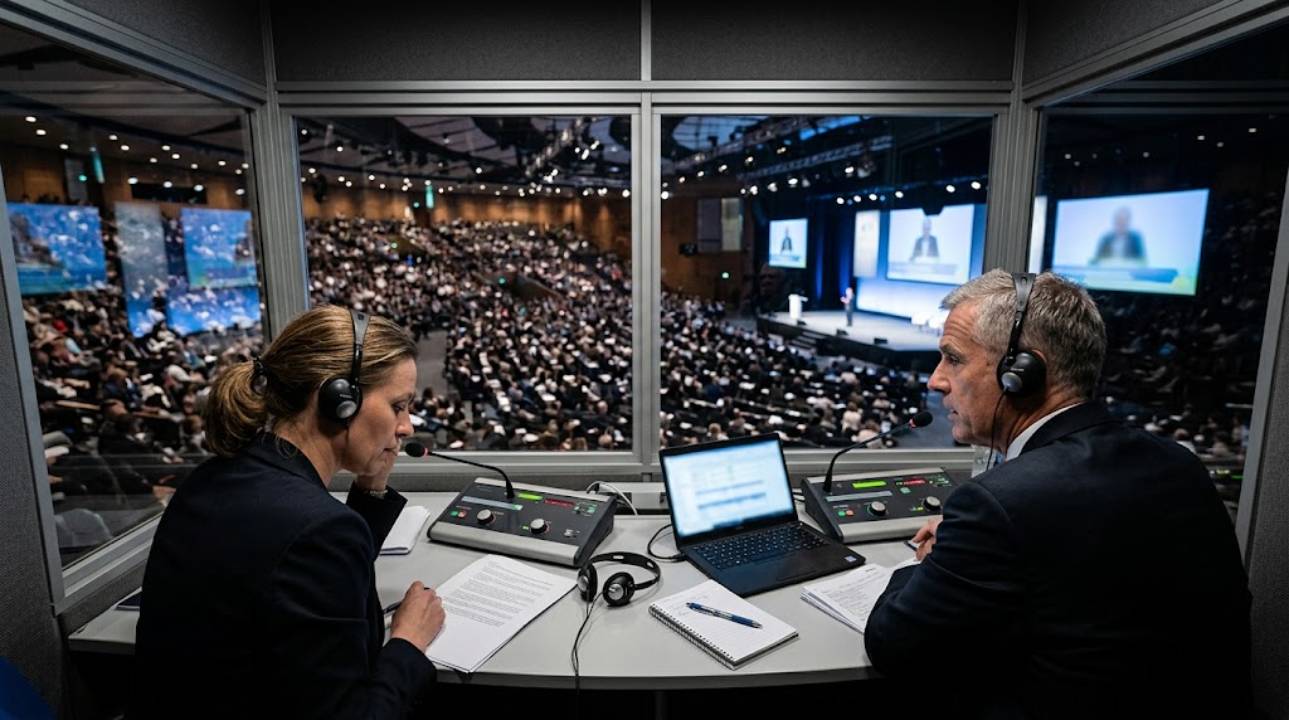
Most people only notice interpreting when it goes wrong. A delegate frowns at a strange phrase, a speaker's joke falls flat in the other language, or a negotiation stalls because a number was misunderstood. When interpreting goes right, it becomes almost invisible. The conversation simply flows, and participants forget that they are speaking different languages at all.
That invisibility is the result of skill, preparation and experience. Plenty of bilingual people can help in a casual conversation, and many trained interpreters deliver solid, reliable work. But the interpreters that event organisers, law firms and international companies book again and again share a set of qualities that go beyond language ability.
They prepare as if they were presenting
Great interpreters treat preparation as part of the job, not as an optional extra. Before a conference, they request the programme, speaker biographies, slide decks and any previous reports. Before a technical meeting, they study the product, the process or the regulation under discussion. They build glossaries of specialised terms and check how the client's own organisation refers to its products and departments.
This preparation pays off in the booth. When a speaker suddenly mentions a niche acronym or a brand name, the interpreter already knows how to render it. Many professionals keep their glossaries in digital form, and those who also work as translators often manage terminology inside a CAT tool, which lets them reuse approved terms across written and spoken assignments for the same client.
They master more than vocabulary
Language interpretation involves converting meaning, not words. A great interpreter listens for intention, tone and implication. They recognise when a speaker is being ironic, cautious or deliberately vague, and they carry that nuance into the target language. In diplomatic or commercial settings, the difference between a firm refusal and a polite hesitation can change the outcome of a meeting.
Cultural knowledge is part of this. An expression that sounds friendly in one culture may sound too familiar in another. Titles, forms of address and the level of formality all need to be adjusted. Interpreters who have lived in the countries whose languages they work with tend to handle these shifts naturally.
They manage pressure and fatigue
Simultaneous interpreting is one of the most mentally demanding professional tasks. The interpreter listens, analyses, reformulates and speaks at the same time, often for long stretches. This is why professional standards call for teams of at least two interpreters per booth, taking turns every twenty to thirty minutes. Great interpreters respect these limits because they know that quality drops when fatigue sets in.
They also stay calm when things go wrong. A speaker reads a dense text at high speed, the audio feed crackles, or a panellist switches languages without warning. Experienced professionals have strategies for each of these situations, from summarising more tightly to signalling technical problems to the organiser without disrupting the event.
They know their language pairs deeply
Clients sometimes assume that anyone who speaks two languages can interpret in both directions equally well. In reality, most interpreters have a stronger active language and choose their assignments accordingly. Demand for certain combinations has grown sharply in recent years. Organisations working in Eastern Europe, for example, often need interpreters and translators who move comfortably between English, Russian and Ukrainian.
These assignments frequently come with written material as well. Background documents, contracts and presentations may need to be prepared in advance, and specialised Russian translation services help ensure that the documents shared around the table use the same terminology the interpreters will use in the booth. Humanitarian organisations, reconstruction projects and businesses entering new markets also rely on careful English to Ukrainian translation for reports, training materials and public information, so that local partners receive content that reads naturally rather than sounding translated.
They protect confidentiality
Interpreters regularly hear information that is commercially sensitive or legally privileged. Board discussions, merger negotiations, medical consultations and court hearings all depend on absolute discretion. Great interpreters follow strict professional codes of ethics, sign non-disclosure agreements without hesitation and never discuss assignments outside the job. This reliability is one of the main reasons clients return to the same professionals year after year.
They adapt to new formats
The profession has changed considerably with the rise of remote meetings. Video conferences, hybrid events and online webinars now account for a large share of assignments. Great interpreters have invested in professional headsets, stable internet connections and quiet workspaces. They know how to work on remote simultaneous interpreting platforms and how to coordinate with a booth partner who may be in another city. They also advise clients on the technical setup needed for good sound quality, since poor audio remains the biggest threat to accurate remote interpreting.
They build relationships with clients
Beyond individual skills, the best interpreters understand that each client has its own culture and expectations. They ask for feedback after an assignment, remember the preferences of regular speakers and suggest improvements for future events. Over time, they become trusted partners who understand the organisation almost as well as its own staff.
How to find the right interpreter
For organisations looking to hire, a few questions help identify the right professional. Ask about training and accreditation, relevant subject experience and references from similar events. Check whether the interpreter will work alone or in a team, and what preparation material they need. Discuss the format, whether on site, remote or hybrid, and the equipment required. Finally, allow enough time for preparation, since even the most experienced interpreter performs better with a proper briefing.
The value of getting it right
Choosing an interpreter based only on price can be a costly mistake. A misunderstanding during a negotiation, a medical appointment or a legal hearing can have consequences far beyond the fee saved. The difference between a good interpreter and a great one lies in preparation, judgement and reliability. When those qualities are present, language stops being a barrier and becomes a bridge between people who need to understand each other.